
Showing posts with label math. Show all posts
Showing posts with label math. Show all posts
Friday, March 22, 2013
Fortune cookie
Ha ha ha! Look what it said in my fortune cookie the other day as I was writing about the quirks of my nonlinear inversion... The fortune cookie described the trouble exactly!


Friday, August 17, 2012
A&S for the 21st century
Sweet, I just discovered that the old classic 1000-page mathematical reference Abramowitz and Stegun has been updated and distributed for the new millennium (well, and century too) in a more modern way. It's all there free on its own NIST website (the National Institute of Standards and Technology were the ones who published A&S in the first place back in the 1960s). Here it is right here:
It was released just two years ago, with both a book version and this online version, which as far as I can tell is a superset of the book. Here are the three coolest practical aspects of the website version:
- next to each equation there's a permalink so you can reference a link straight back to the original section of the equation reference
- and perhaps even better, also next to each equation there's a link to the TeX source for the equation, so you don't even have to rework it all up in TeX again yourself when using it.
- and even better than that! - ALSO in each section is a list of links to modern software references for finding software libraries & codes to compute the quantities discussed in each section. (typically in Fortran; note for each code the link puts you at a bibliography entry for a relevant journal paper, but at the right of that ref there's another link that'll get you to the code and other related documents)

NIST Digital Library of Mathematical Functions
(Note the Riemann zeta function used in their cover plot - for these 3D plots you can even interactively go zip around in them via VRML and X3D)
Wednesday, August 1, 2012
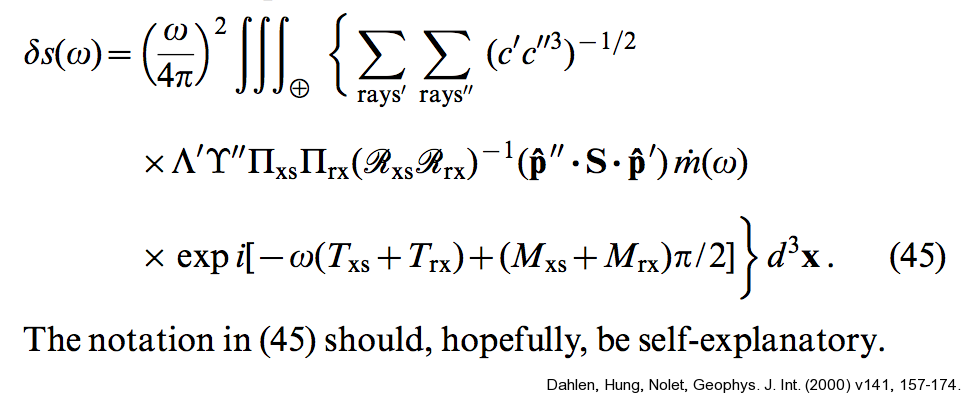
Self-explanatory
Alas this is snipped out of a real geophysics research paper - an important and seminal one at that (Dahlen et al's "banana-donut" paper on ray sensitivity kernels). So freakin' typical and stereo-typical at the same time...
Tuesday, July 3, 2012
Tradeoff using central finite differences
Arggg! (But yay!) Well my collaborator and I finally figured out why the spectra we were computing were unexpectedly rolling off in the higher wavenumber end. We were calculating spectra of the derivative of our data series, and were using central finite differences to approximate that derivative. We'd figured that central differences were more accurate than forward differences and so we were using those (via Matlab's gradient() function), but we realized - ahem, in hindsight - that there's an important tradeoff to be aware of there. Since the central differences approximate the derivative using the point before and after the present point, it's effectively averaging over three points, and gives you a low-pass filtered version of the derivative. Forward (and backward) first finite differences do this too but over fewer points (two instead of three) so it's not so big an effect. The central diffs caused a big enough effect to be a problem in our work, while the forward diffs do not. Note it depends what aspect of the derivative is most important to you though - phase offset vs frequency rolloff.
In the end we computed the derivative more directly anyway by transforming to the wavenumber domain and multiplying by ik, just to avoid the whole issue. At any rate, I noticed Terry Bahill (retired from Univ Arizona) has a nice brief paper that sums it up well. @#$%, can't believe I didn't notice this earlier...
In the end we computed the derivative more directly anyway by transforming to the wavenumber domain and multiplying by ik, just to avoid the whole issue. At any rate, I noticed Terry Bahill (retired from Univ Arizona) has a nice brief paper that sums it up well. @#$%, can't believe I didn't notice this earlier...
Subscribe to:
Posts (Atom)